
Proof exists that reducing sugar and fat intake leads to higher IQs and improved grades in school as well as reducing violence!
Christina Pirello, authority on natural and whole foods posted this article yesterday about changing school cafeteria menus. http://www.huffingtonpost.com/christina-pirello/can-we-cut-crime-by-chang_b_460649.html
An interesting idea!
Showing posts with label bottled water. Show all posts
Showing posts with label bottled water. Show all posts
Tuesday, February 16, 2010

Friday, January 22, 2010
Crystal Light Launches "Water Your Body" Campaign
Kraft brand Crystal Light has sponsored the January 2010 issue of People Extra launching their new campaign, "Water Your Body". With a focus on health and hydration, Crystal Light is recommending their drinkers to "Water Up." Thankfully, they recommend using a special water glass or a reusable bottle and not individually bottled water that end up in landfills! Visit crystallight.com to find out how you can drink more water.
Tuesday, December 1, 2009
Is the bottled water industry dead? $16 billion in annual sales says no
The blog Triple Pundit has a really thought-provoking article about the future of the bottled water industry.
One salient point that the author makes is that the so-called "refill revolution" is still in its nascent phase. While campaigns such as Break Free have raised awareness of plastic bottle waste and converted people from single-serve bottled water to alternative such as water coolers, tap and filters, the bottled water industry is still billions of dollars strong.
If you haven't already signed the Break Free pledge, do it now. Then, encourage your friends, family and coworkers to do the same. But don't just take the pledge. Live it.
Remember:
One salient point that the author makes is that the so-called "refill revolution" is still in its nascent phase. While campaigns such as Break Free have raised awareness of plastic bottle waste and converted people from single-serve bottled water to alternative such as water coolers, tap and filters, the bottled water industry is still billions of dollars strong.
Sales of reusable aluminum and stainless steal water bottles are up. Companies like Sigg and Klean Kanteen have grown tremendously over the past few years; Nalgene has experienced slower sales due to the BPA scare. Sigg increased production by more than 90 percent last year and expects it to increase to be about seven million this year (though a recent scandal regarding lack of transparency could change that).Those of us who are concerned about the environment and plastic bottle waste should let this reality motivate us to do more to cut into the bottled water industry's profit: It would take a mass exodus of people using refillable water bottles to take away the significant market share of the bottled water industry.
But the bottled water industry is enormous, estimated at about $16 billion, and reusable water bottles are a mere drop in the bucket. It would take a mass exodus of people using refillable water bottles to take away the significant market share of the bottled water industry.
If you haven't already signed the Break Free pledge, do it now. Then, encourage your friends, family and coworkers to do the same. But don't just take the pledge. Live it.
Remember:
The benefits of using reusable water bottles far outweigh the costs. Among these benefits are: energy savings and reduced emissions (processing, packaging, distribution) and reduced waste (less plastic in landfills equals less pollution).
Friday, November 13, 2009
Bottled Water is for the dogs
Here's another one for the Hall of Shame.
A company in Japan is marketing a line of bottled water for dogs called "Pet Sweat."

First of all, what were they thinking when they named this product? Pet Sweat - ick! And what a colossal waste of money and natural resources. This one is worse than the Hello Kitty water bottles.
What's even more disturbing is that the ill-conceived, horribly named Pet Sweat isn't the only bottled water being marketed to pet owners.
As blogger Dogtopia points out, "Pet Sweat could take the lead from American manufacturers of bottled water for dogs, with names such as Fortifido, Hero Dog Water, Woof Water, PetRefresh, Aqua Dog, and Dog Whisperer Fortified Water for Dogs. Yet, 99% of dogs surveyed said they would still prefer to drink water out of the toilet."
Please don't buy these products for your pet. If you're worried about your pooch getting thirsty, carry a collapsible bowl along on your walks and fill it from a reusable water bottle.
A company in Japan is marketing a line of bottled water for dogs called "Pet Sweat."

First of all, what were they thinking when they named this product? Pet Sweat - ick! And what a colossal waste of money and natural resources. This one is worse than the Hello Kitty water bottles.
What's even more disturbing is that the ill-conceived, horribly named Pet Sweat isn't the only bottled water being marketed to pet owners.
As blogger Dogtopia points out, "Pet Sweat could take the lead from American manufacturers of bottled water for dogs, with names such as Fortifido, Hero Dog Water, Woof Water, PetRefresh, Aqua Dog, and Dog Whisperer Fortified Water for Dogs. Yet, 99% of dogs surveyed said they would still prefer to drink water out of the toilet."
Please don't buy these products for your pet. If you're worried about your pooch getting thirsty, carry a collapsible bowl along on your walks and fill it from a reusable water bottle.
Thursday, November 5, 2009
Bottled water's role in pollution
NorthJersey.com has an informative article that talks about how bottled water is a huge pollutant.
While we don't agree writer's conclusion that drinking tap water is the only option that consumers who want to green their lifestyle have, the article makes some great points about how environmentally irresponsible bottled water consumption is:
While we don't agree writer's conclusion that drinking tap water is the only option that consumers who want to green their lifestyle have, the article makes some great points about how environmentally irresponsible bottled water consumption is:
- An estimated 17 million barrels of oil were used to make plastic water bottles in 2006, producing 2.5 million tons of carbon dioxide.
- Energy is also consumed to fill, transport, refrigerate, and dispose of all these bottles.
- Worldwide bottling of water uses about 2.7 million tons of plastic each year.
Wednesday, November 4, 2009

Thursday, October 29, 2009
Judge issues $1.26 billion judgment against PepsiCo in bottled water lawsuit
Did you hear about the harried PepsiCo secretary who failed to pass along important legal documents relating to a bottled water lawsuit to her boss?
Her oversight may cost the company $1.26 billion -- and we're betting the secretary's job -- after a judge issued a default judgment in that amount to two men who filed suit alleging that PepsiCo stole their idea for bottling water. The judge issued the summary judgment last month when PepsiCo failed to appear in court. PepsiCo is appealing the ruling.
Here, in a nutshell is what happened:
Her oversight may cost the company $1.26 billion -- and we're betting the secretary's job -- after a judge issued a default judgment in that amount to two men who filed suit alleging that PepsiCo stole their idea for bottling water. The judge issued the summary judgment last month when PepsiCo failed to appear in court. PepsiCo is appealing the ruling.
Here, in a nutshell is what happened:
Charles Joyce, of Juneau, Wis., and James Voigt, of Cleveland, Wis., sued PepsiCo in April, asking for a jury trial and damages of more than $75,000. Their lawyer, David Van Dyke, told The Associated Press the two had worked together and came up with the idea to bottle purified water in individual servings.Joyce's and Voigt's lawsuit accuses PepsiCo of misusing trade secrets. It also names Wis-Pak Inc. and Carolina Canners Inc., companies that make and distribute PepsiCo products, and Thomas M. Hiles, then the executive vice-president of Carolina Canners.
The pair claim they entered written confidentiality agreements about a new beverage they were calling "U.P." with executives of Wis-Pak and Carolina Canners in 1981. The executives violated the agreements and gave the information to PepsiCo, which eventually rolled out a bottled water brand - Aquafina - about a dozen years later, Joyce and Voigt claim.
PepsiCo said part of the problem was it was served the lawsuit in North Carolina, where it is incorporated, instead of Purchase, N.Y., where it is based. Later, a secretary who received letters relating to the case failed to act on them.Spokesman Joe Jacuzzi said PepsiCo wants to fight the claims but acknowledges it failed to respond because of "an internal process issue."
PepsiCo says it never knew anything about the case. Here's what it told the court on Oct. 13 when it asked the court to abandon the judgment.
-June 11: Stith&Stith, PepsiCo's law firm in North Carolina, is "allegedly" served with the complaint but the company gets no word.
-Sept. 15: Stith&Stith forwards a letter about the case to Tom Tamoney in PepsiCo's legal department, but his secretary, Kathy Henry, "was so busy preparing for a board meeting she did not deliver it to anyone" or tell anyone about it or enter it into a log that tracks such things, according to PepsiCo's court filing.
Despite the default judgment, it's likely that PepsiCo will get its day in court to defend against the $1.26 billion lawsuit, according to a law professor interviewed by The Associated Press.
Wednesday, October 28, 2009
Hello Kitty shilling for bottled water
Bottled water is a trend whose trendiness has long passed. Or so we thought, until we saw these horrible, horrible Hello Kitty water bottles, which apparently are available exclusively at 7 Eleven stores in Japan.

We hope that Japanese consumers and Hello Kitty collectors are smart enough to not buy these wasteful water bottles.

We hope that Japanese consumers and Hello Kitty collectors are smart enough to not buy these wasteful water bottles.
Wednesday, October 21, 2009
Bottled water versus tap
We've been lurking around the Web today, eavesdropping on arguments between bottled water proponents and environmentalists who've are pushing the tap water agenda.
Check out the the spirited debate over at Fake Plastic Fish regarding the new documentary Tapped.
Some of the most pointed comments are from the author of arduous blog and Tom Lauria of the International Bottled Water Association.
Check out the the spirited debate over at Fake Plastic Fish regarding the new documentary Tapped.
Some of the most pointed comments are from the author of arduous blog and Tom Lauria of the International Bottled Water Association.
Declining soda and bottled water sales hurt Coke's third quarter 2009 profits
Coca-Cola recorded only a slight profit for the third quarter, as it reported that North American sales of sodas and its Dasani-brand bottled water dipped 4 percent for the quarter.
As a result, Coke has increased its spending on advertising, marketing and packaging in North America, while also growing its business in emerging markets such as China and India.
Declining sales of Dasani, fueled by consumer backlash against bottled water for economic and environmental reasons, were a big drag on Coke's profits for the quarter.
According to coverage by the Wall Street Journal, "sales of Dasani brand water in North America were down by more than 19 percent. Sales of multipacks of Dasani, a popular packaging for water, were down even more."
As a result, Coke has increased its spending on advertising, marketing and packaging in North America, while also growing its business in emerging markets such as China and India.
Declining sales of Dasani, fueled by consumer backlash against bottled water for economic and environmental reasons, were a big drag on Coke's profits for the quarter.
According to coverage by the Wall Street Journal, "sales of Dasani brand water in North America were down by more than 19 percent. Sales of multipacks of Dasani, a popular packaging for water, were down even more."
Tuesday, October 20, 2009
Penn State environmental group calls for campus bottled water ban
An environmental group at Penn State is speaking out against bottled water.
Members of Environment, Ecology and Education in the College of Education "called on the university to end its contract with Aquafina, noting that the stuff in the bottle is not better than what comes out of the tap, costs too much and creates unwanted plastic waste," according to the Pocono Record.
The group asked students to sign a petition against bottled water and to rethink their own consumption of it.
We agree with their message that bottled water is a wasteful from an environmental standpoint. But we don't agree that drinking tap water is the only solution. Tap water has its own set of problems -- water quality being prime among them.
Saying that drinking tap water is the only alternative to bottled water is akin to abstinence-only sex education.
While the either-or message will resonate with some people, who will switch to tap water, there will be others who don't like the tap option. And they'll hop right back into bed with bottled water because they don't realize there's another alternative -- a water dispenser.
Members of Environment, Ecology and Education in the College of Education "called on the university to end its contract with Aquafina, noting that the stuff in the bottle is not better than what comes out of the tap, costs too much and creates unwanted plastic waste," according to the Pocono Record.
The group asked students to sign a petition against bottled water and to rethink their own consumption of it.
We agree with their message that bottled water is a wasteful from an environmental standpoint. But we don't agree that drinking tap water is the only solution. Tap water has its own set of problems -- water quality being prime among them.
Saying that drinking tap water is the only alternative to bottled water is akin to abstinence-only sex education.
While the either-or message will resonate with some people, who will switch to tap water, there will be others who don't like the tap option. And they'll hop right back into bed with bottled water because they don't realize there's another alternative -- a water dispenser.
Monday, October 19, 2009
Did you hear the one about bottled water?
From comedian Lizz Winstead:
"We buy bottled water every single day without thinking about it. Why? Because drinking tap water is more dangerous than doing Jell-O shots off of Courtney Love, that's why."

Funny and unfortunately probably true.
"We buy bottled water every single day without thinking about it. Why? Because drinking tap water is more dangerous than doing Jell-O shots off of Courtney Love, that's why."

Funny and unfortunately probably true.
Thursday, October 15, 2009
Disturbing Fact: Americans consume 1,500 bottles of water every second
And we throw away 1,200 of them.
 MSLK, a New York design agency, is artfully raising consciousness about plastic waste with Watershed, an art installation in New York.
Watershed is essentially a curtain of 1,500 empty plastic water bottles. The number is signficant because every second, Americans consume 1,500 bottles of water.
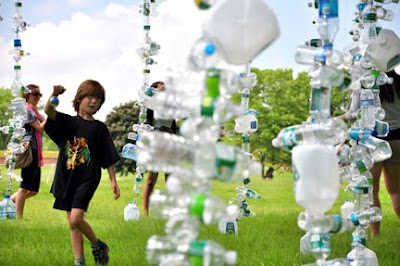
 MSLK, a New York design agency, is artfully raising consciousness about plastic waste with Watershed, an art installation in New York.
Watershed is essentially a curtain of 1,500 empty plastic water bottles. The number is signficant because every second, Americans consume 1,500 bottles of water.

Saturday, October 10, 2009
More creative recycling of water bottles
While it's no Plastiki, you have to applaud Micah Weiss's ingenuity in building a pontoon boat from hundreds of discarded water bottles.
He documents the process at Project rRaft and provides detailed instructions for other eco-minded do-it-yourselfers at Instructables.
He documents the process at Project rRaft and provides detailed instructions for other eco-minded do-it-yourselfers at Instructables.
Wednesday, October 7, 2009

New York To Require Deposits on Bottled Water
Later this month, New York will begin requiring a 5-cent deposit on bottled water. New Yorkers already have to pay a deposit when they purchase sodas, carbonated beverages, wine coolers and beer. That deposit is refundable if they return the empty bottles and cans to a local store for recycling.
Consumer sentiments about the new law are mixed. Some resident believe the deposits will have a positive environmental impact because they will discourage people from trashing their empty water bottles. But others are bemoaning the fact that the new law will raise the price of a case of water by more than $2.
New York state, where some 2.5 billion bottles of water are sold annually, is one of only 11 states that requires deposits on bottled and canned beverages. It is one of only six states requiring deposits on bottled water. Connecticut just began requiring a 5-cent deposit on bottled water on Oct. 1.
Bottle bills usually dramatically improve recycling rates in the states where they are enacted. So, it's likely that New Yorkers will stop contributing to the steady stream of bottled water waste that winds up in landfills.
State officials are projecting an increase in recycling, according to an article on MPNnow.com:
Consumer sentiments about the new law are mixed. Some resident believe the deposits will have a positive environmental impact because they will discourage people from trashing their empty water bottles. But others are bemoaning the fact that the new law will raise the price of a case of water by more than $2.
New York state, where some 2.5 billion bottles of water are sold annually, is one of only 11 states that requires deposits on bottled and canned beverages. It is one of only six states requiring deposits on bottled water. Connecticut just began requiring a 5-cent deposit on bottled water on Oct. 1.
Bottle bills usually dramatically improve recycling rates in the states where they are enacted. So, it's likely that New Yorkers will stop contributing to the steady stream of bottled water waste that winds up in landfills.
State officials are projecting an increase in recycling, according to an article on MPNnow.com:
“Water is about 25 percent of the overall beverage market,” said Laura Haight, senior environmental associate for the New York Public Interest Research Group. “With the expansion, we’re capturing about 90 percent of the beverages we believe should have deposits on them.”
Earlier state laws required deposits on soda and other carbonated beverages, wine coolers and beer, with a study showing they raised aluminum can recycling from less than 20 percent to more than 80 percent.
Monday, October 5, 2009
Better Homes & Gardens Blogger Breaks Free from Bottled Water
Better Homes & Gardens editor and blogger Amanda Hyde took the Break Free pledge, and she's happy that she did.
Amanda writes about how she kicked her bottled water addiction with the help of a Primo Water dispenser for her home and a pair of reusable Nalgene bottles.
She reports that she's saving money while also saving the environment.
Are you ready to Break Free, too?
Amanda writes about how she kicked her bottled water addiction with the help of a Primo Water dispenser for her home and a pair of reusable Nalgene bottles.
She reports that she's saving money while also saving the environment.
Following the arrival of the water cooler, I went to Lowe’s to purchase the 5-gallon bottle and I picked up two Nalgene water bottles. For the past 2-1/2 weeks, I’ve been filling my water bottles with Primo Water before work, after a workout, and whenever I’m thirsty. It’s taken a little time to get used to preparing my own water bottles, but I’ve honestly come to love this product! It’s so easy to use and the water is refreshing and great-tasting. Plus, the stylish dispenser looks great in my kitchen!Great job, Amanda!
I’m also thrilled about the money I'm saving! I used to spend $10 each week for 12 bottled waters. It only cost me $14 to purchase Primo’s 5-gallon bottle and it will only cost $6.00 to refill it when the time comes.
Are you ready to Break Free, too?
Thursday, October 1, 2009
California County Bans Bottled Water and Water Coolers
It's tap water only for government employees in Sonoma County, California.
Elected officials there have banned bottled water and water coolers from county government buildings out of budget and environmental concerns. The move will save the local government $70,000 annually, according to local press coverage.
As in most places, Sonoma County has a glut of plastic bottles in its landfills. Only about 20 percent of plastic bottles are recycled; the rest are trashed, according to the newspaper.
While water dispensers are an environmentally responsible alternative to bottled water, Sonoma County supervisers voted to get rid of them, too, to save $45,000 annually, in cooler rental and water fees.
Elected officials there have banned bottled water and water coolers from county government buildings out of budget and environmental concerns. The move will save the local government $70,000 annually, according to local press coverage.
As in most places, Sonoma County has a glut of plastic bottles in its landfills. Only about 20 percent of plastic bottles are recycled; the rest are trashed, according to the newspaper.
While water dispensers are an environmentally responsible alternative to bottled water, Sonoma County supervisers voted to get rid of them, too, to save $45,000 annually, in cooler rental and water fees.
New laws taking effect Oct. 1 to impact bottled water drinkers
New laws taking effect today in several states will have an impact on bottled water drinkers.
Beginning today, residents of Connecticut will have to pay a 5 cent deposit on every bottle of water they buy. This extends the state's existing bottle bill, which requires consumers to pay a refundable deposit on beverage purchases.
Bottle bills, while they do generate revenues for states, also are aimed at improving recycling rates. Customers receive a refund only when they return their empty bottles to the store, where they are collected and recycled. By the end of the year, six states will require deposits on bottled water.
Here in North Carolina, Primo Water's home state, it's now illegal to throw plastic bottles and containers in the trash. We applaud the state's efforts to encourage mandatory recycling on plastic bottles, but we realize that enforcing this law will be difficult and perhaps even unpopular.
But it is so necessary. DigTriad reports that four of every five plastic containers are thrown away instead of recycled. According to the N.C. Division of Pollution Prevention and Environmental Assistance, only 18 percent of plastic bottles used in the state are recycled. That's the height of environmental irresponsibility.
According to the city of Greensboro, if every plastic bottle used in the state were recycled, that would keep more than 2.4 billion plastic bottles from landfills annually.
The new law sends the message to residents that we can't keep throwing plastic into our landfills. Because of the number of plastic bottles that are trashed annually -- billions -- we're already facing huge environmental consequences for this wasteful behavior. The new law makes those consequences more immediate. Throw away plastic containers in North Carolina instead of recycling them and face a potential fine.
Actually, North Carolina residents don't have to worry about being fined for tossing an empty bottle in the trash instead of the recycling ban. But state inspectors will be looking for trash haulers who dump loads of plastic and other banned materials in landfills.
Here's more on enforcement of the new plastic bottle ban from Earth911:
Of course, laws like this would be moot if more people would take the pledge and Break Free from bottled water and reduce their overall consumption of plastic bottles and containers.
Beginning today, residents of Connecticut will have to pay a 5 cent deposit on every bottle of water they buy. This extends the state's existing bottle bill, which requires consumers to pay a refundable deposit on beverage purchases.
Bottle bills, while they do generate revenues for states, also are aimed at improving recycling rates. Customers receive a refund only when they return their empty bottles to the store, where they are collected and recycled. By the end of the year, six states will require deposits on bottled water.
Here in North Carolina, Primo Water's home state, it's now illegal to throw plastic bottles and containers in the trash. We applaud the state's efforts to encourage mandatory recycling on plastic bottles, but we realize that enforcing this law will be difficult and perhaps even unpopular.
But it is so necessary. DigTriad reports that four of every five plastic containers are thrown away instead of recycled. According to the N.C. Division of Pollution Prevention and Environmental Assistance, only 18 percent of plastic bottles used in the state are recycled. That's the height of environmental irresponsibility.
According to the city of Greensboro, if every plastic bottle used in the state were recycled, that would keep more than 2.4 billion plastic bottles from landfills annually.
The new law sends the message to residents that we can't keep throwing plastic into our landfills. Because of the number of plastic bottles that are trashed annually -- billions -- we're already facing huge environmental consequences for this wasteful behavior. The new law makes those consequences more immediate. Throw away plastic containers in North Carolina instead of recycling them and face a potential fine.
Actually, North Carolina residents don't have to worry about being fined for tossing an empty bottle in the trash instead of the recycling ban. But state inspectors will be looking for trash haulers who dump loads of plastic and other banned materials in landfills.
Here's more on enforcement of the new plastic bottle ban from Earth911:
It’s not going to be a Big Brother law, but the best way to be in compliance with the law is to recycle plastic bottles,” says Scott Mouw, environmental supervisor for the North Carolina Department of the Environment and Natural Resources. “Everyone wants to do the right thing, and the right thing is to recycle.”While we don't believe that garbage cops should target individuals, we do hope that this new law will encourage more people to recycle plastics. Many municipalities in the state offer curbside recycling, making it so easy for residents to recycle. We'd also love to see more restaurants and public venues offer recycling bins alongside trash cans.
Of course, laws like this would be moot if more people would take the pledge and Break Free from bottled water and reduce their overall consumption of plastic bottles and containers.
Tuesday, September 29, 2009
Bottled water versus tap water
The president of the International Bottled Water Association and the director of the Environmental Working Group's California office squared off recently over whether tap water or bottled water is safer.
The interview of EWG's Renee Sharp and IBWA's Joe , broadcast on KPBS, was in response to Congressional debate earlier this summer calling for stricter regulation and additional labeling of bottled water.
Obviously both of these speakers have agendas, but theirs is a pretty thorough discussion of the safety different regulations governing bottled and tap water.
The transcript of their interview, broadcast on KPBS, is available here.
The interview of EWG's Renee Sharp and IBWA's Joe , broadcast on KPBS, was in response to Congressional debate earlier this summer calling for stricter regulation and additional labeling of bottled water.
Obviously both of these speakers have agendas, but theirs is a pretty thorough discussion of the safety different regulations governing bottled and tap water.
The transcript of their interview, broadcast on KPBS, is available here.
Subscribe to:
Posts (Atom)


 Posts
Posts

