
Could it be any easier?
Friday, October 30, 2009

Thursday, October 29, 2009
Deadly E.Coli detected in Oklahoma restaurant's tap water
After one man died and hundreds of others became ill after drinking E.coli tainted well water at an Oklahoma restaurant, the state is urging others with wells to switch to bottled water or municipal tap water.
The Tulsa World newspaper reported that the Department of Environmental Quality and the Oklahoma Department of Agriculture, Food and Forestry have said that residents of Locust Grove, Okla., who rely on well water should take precautions to avoid ingesting the deadly bacteria.
The Tulsa World newspaper reported that the Department of Environmental Quality and the Oklahoma Department of Agriculture, Food and Forestry have said that residents of Locust Grove, Okla., who rely on well water should take precautions to avoid ingesting the deadly bacteria.
Judge issues $1.26 billion judgment against PepsiCo in bottled water lawsuit
Did you hear about the harried PepsiCo secretary who failed to pass along important legal documents relating to a bottled water lawsuit to her boss?
Her oversight may cost the company $1.26 billion -- and we're betting the secretary's job -- after a judge issued a default judgment in that amount to two men who filed suit alleging that PepsiCo stole their idea for bottling water. The judge issued the summary judgment last month when PepsiCo failed to appear in court. PepsiCo is appealing the ruling.
Here, in a nutshell is what happened:
Her oversight may cost the company $1.26 billion -- and we're betting the secretary's job -- after a judge issued a default judgment in that amount to two men who filed suit alleging that PepsiCo stole their idea for bottling water. The judge issued the summary judgment last month when PepsiCo failed to appear in court. PepsiCo is appealing the ruling.
Here, in a nutshell is what happened:
Charles Joyce, of Juneau, Wis., and James Voigt, of Cleveland, Wis., sued PepsiCo in April, asking for a jury trial and damages of more than $75,000. Their lawyer, David Van Dyke, told The Associated Press the two had worked together and came up with the idea to bottle purified water in individual servings.Joyce's and Voigt's lawsuit accuses PepsiCo of misusing trade secrets. It also names Wis-Pak Inc. and Carolina Canners Inc., companies that make and distribute PepsiCo products, and Thomas M. Hiles, then the executive vice-president of Carolina Canners.
The pair claim they entered written confidentiality agreements about a new beverage they were calling "U.P." with executives of Wis-Pak and Carolina Canners in 1981. The executives violated the agreements and gave the information to PepsiCo, which eventually rolled out a bottled water brand - Aquafina - about a dozen years later, Joyce and Voigt claim.
PepsiCo said part of the problem was it was served the lawsuit in North Carolina, where it is incorporated, instead of Purchase, N.Y., where it is based. Later, a secretary who received letters relating to the case failed to act on them.Spokesman Joe Jacuzzi said PepsiCo wants to fight the claims but acknowledges it failed to respond because of "an internal process issue."
PepsiCo says it never knew anything about the case. Here's what it told the court on Oct. 13 when it asked the court to abandon the judgment.
-June 11: Stith&Stith, PepsiCo's law firm in North Carolina, is "allegedly" served with the complaint but the company gets no word.
-Sept. 15: Stith&Stith forwards a letter about the case to Tom Tamoney in PepsiCo's legal department, but his secretary, Kathy Henry, "was so busy preparing for a board meeting she did not deliver it to anyone" or tell anyone about it or enter it into a log that tracks such things, according to PepsiCo's court filing.
Despite the default judgment, it's likely that PepsiCo will get its day in court to defend against the $1.26 billion lawsuit, according to a law professor interviewed by The Associated Press.
Wednesday, October 28, 2009
Hello Kitty shilling for bottled water
Bottled water is a trend whose trendiness has long passed. Or so we thought, until we saw these horrible, horrible Hello Kitty water bottles, which apparently are available exclusively at 7 Eleven stores in Japan.

We hope that Japanese consumers and Hello Kitty collectors are smart enough to not buy these wasteful water bottles.

We hope that Japanese consumers and Hello Kitty collectors are smart enough to not buy these wasteful water bottles.
Wednesday, October 21, 2009
Bottled water versus tap
We've been lurking around the Web today, eavesdropping on arguments between bottled water proponents and environmentalists who've are pushing the tap water agenda.
Check out the the spirited debate over at Fake Plastic Fish regarding the new documentary Tapped.
Some of the most pointed comments are from the author of arduous blog and Tom Lauria of the International Bottled Water Association.
Check out the the spirited debate over at Fake Plastic Fish regarding the new documentary Tapped.
Some of the most pointed comments are from the author of arduous blog and Tom Lauria of the International Bottled Water Association.
Declining soda and bottled water sales hurt Coke's third quarter 2009 profits
Coca-Cola recorded only a slight profit for the third quarter, as it reported that North American sales of sodas and its Dasani-brand bottled water dipped 4 percent for the quarter.
As a result, Coke has increased its spending on advertising, marketing and packaging in North America, while also growing its business in emerging markets such as China and India.
Declining sales of Dasani, fueled by consumer backlash against bottled water for economic and environmental reasons, were a big drag on Coke's profits for the quarter.
According to coverage by the Wall Street Journal, "sales of Dasani brand water in North America were down by more than 19 percent. Sales of multipacks of Dasani, a popular packaging for water, were down even more."
As a result, Coke has increased its spending on advertising, marketing and packaging in North America, while also growing its business in emerging markets such as China and India.
Declining sales of Dasani, fueled by consumer backlash against bottled water for economic and environmental reasons, were a big drag on Coke's profits for the quarter.
According to coverage by the Wall Street Journal, "sales of Dasani brand water in North America were down by more than 19 percent. Sales of multipacks of Dasani, a popular packaging for water, were down even more."
What's In Your Tap Water?
Local governments are quick to assure the public that our drinking water is safe.
But how safe is it really?
If you want to see for yourself what contaminants are present in your tap water, check out this nifty Drinking Water Scorecard from the University of Cincinnatti.
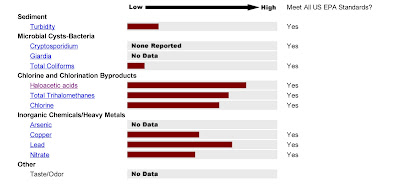
While contaminant levels in our local water meet all EPA standards, the levels of lead, chlorine and chlorine byproducts are particularly concerning.
Lead can impact children's mental and physical development and can contribute to kidney and blood pressure problems in adults. Chlorine byproducts have been linked to an increased risk for cancer.
But, according ot the EPA, our drinking water is safe.
But how safe is it really?
If you want to see for yourself what contaminants are present in your tap water, check out this nifty Drinking Water Scorecard from the University of Cincinnatti.
Do you know what's in your drinking water? Did you know the drinking water quality, or the amount of contaminants, varies around the country? Click on your city below to investigate how your drinking water ranks versus other cities.The chart below is for the Greensboro-High Point-Winston-Salem metro area, where Primo Water is based. (Sorry for the quality. You can access the chart here.)

While contaminant levels in our local water meet all EPA standards, the levels of lead, chlorine and chlorine byproducts are particularly concerning.
Lead can impact children's mental and physical development and can contribute to kidney and blood pressure problems in adults. Chlorine byproducts have been linked to an increased risk for cancer.
But, according ot the EPA, our drinking water is safe.
Subscribe to:
Posts (Atom)


 Posts
Posts

